The Connecticut DCI Working Group Focuses on Inclusion
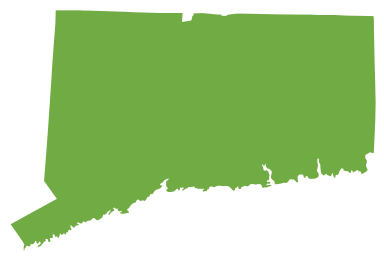
In partnership with: Connecticut Department of Agriculture
According to the 2017 Census of Agriculture, Connecticut is home to 134 producers who identify as Black, Indigenous or people of color (BIPOC), which is equivalent to 1.4% of all producers in the state, plus another 1.4% who identify as Hispanic. However, 20% of the state’s population identifies as people of color. To find a solution to this imbalance, the Connecticut Department of Agriculture (CT DoAg) is focusing on supporting minorities through the Diversity, Equity and Inclusion (DEI) Working Group.

Including All
“CT DoAg was self-motivated to make a change within the agency and industry overall to ensure our support of Connecticut producers was inclusive of all farmers, regardless of their abilities, sexual orientation, ethnicity or language,” says Jaime Smith, CT DoAg bureau director. “Through the award and financial support of a U.S. Department of Agriculture Specialty Crop Block Grant, our vision of soliciting input from the identified community came to fruition.”
Under federal law, socially and economically disadvantaged individuals include those who have been subjected to racial or ethnic prejudice or cultural bias within American society because of their identification as members of groups without regard to their individual qualities. In Connecticut agriculture, the DEI Working Group is primarily focused on the experiences and challenges of producers who identify as BIPOC.
See more: 6 Must-Visit Agritourism Spots in Connecticut
“We know BIPOC producers are out there farming, but our engagement with that community to ensure our programs were supporting them was minimal,” Smith says. “Building relationships to better understand what various communities need from the agency, outside of Caucasian men and women, desperately needed to happen.”
Working toward having the industry’s profile model that of the state would not only encourage more BIPOC producers to engage in farming but also ensure a diverse, culturally relevant food supply in Connecticut.

Growing More Than Greens
Zania Johnson, co-owner of Micro2Life, is involved in the Access to Secure Land Tenure core topic group of the DEI Working Group.
“I’m a minority farmer being young and a person of color,” Johnson says. “People are shocked that my partner and I are the ones growing the food and not the farmer’s assistants. They have a stereotype for a farmer, but we’re proving that anyone can be a farmer.”
See more: How to Grow Your Own Microgreens
Johnson and Emmanuel Marte started Micro2life by growing microgreens indoors and selling them in Hartford until acquiring outdoor space where they began growing in the ground.
“When we started, we were growing 1 ton of produce, and today, we’re getting closer to 4 tons of produce each year,” Marte says.
The farm sits on 1.5 acres in Simsbury and grows culturally relevant crops, including bok choy, collard greens and callaloo, a Caribbean vegetable.
Johnson is Jamaican-American, and Marte’s family is from the Dominican Republic. Their focus on these specialty crops resonates with their customers, who hail from a variety of backgrounds.

Focus on Inclusion
“In Hartford County, there’s a variety of different cultures, including Caribbean, Spanish and more,” Johnson says. “It’s important for people to have access to foods that are growing in their native countries and are part of their culture. Customers ask for specific vegetables, and we aim to meet that demand.”
They have expanded to include more traditional vegetables, such as tomatoes and peppers, but their focus is providing fresh produce to local schools and restaurants.
See more: Soil, Seed, Soul: Improving Diversity in Florida Agriculture

“People have come to expect our crop yields and depend on us,” Johnson says. “The lack of access to land and land security is a real issue because it adds more stress to us. We’ve been renting land, and it doesn’t provide stability like owning land.”
Secure land is a passion of Johnson’s and one of the reasons she joined the DEI Working Group. She is excited to be part of the movement to provide resources and information for BIPOC farmers and help them achieve their dreams.
“I get to be a voice for other BIPOC farmers who are going through the same situation,” Johnson says. “I can recommend resources for the department to add so farmers can feel more secure in what they’re growing and the places they are using to grow.”